
She was on her way from Chouf to Beirut on a cold December night in 2021. While she was holding the steering wheel firmly with both hands, driving calmly and laughing happily to the music she was listening to, Carmen collided with a young man who was crossing the road to the other side, whom she did not see because the streetlights were not working. As a result of the collision, the young man hit the ground and fell on the other side of the road. Carmen, however, did not move from her spot. She remained seated in her car, the engine off, her hands clenched on the steering wheel, her eyes staring into space. She did not get out to check on the young man, as the shock completely paralyzed her, as if time had stopped at the moment of the collision.
Within minutes, people began to gather around the car. Some
were shouting, others pointing their
hands at her, accusing her of trying to flee: "Don't run away! Stay where
you are! The police are on their way!“ The voices grew louder, but Carmen had
no intention of running away, nor was she even able to move her feet.
Carmen later said: “I wasn't thinking about anything! I didn't know how to react! I was just waiting... waiting for it all to end, or for someone to wake me up from this nightmare!"

After the police arrived and took her to the nearest station, the officers stood beside her and spoke to each other in low voices, but their heavy words did not escape her ears. They were discussing among themselves whether to let her sleep at the station that night if the young man had died. After hearing those words, Carmen felt as if she were in a cage from which she could not escape. The station was not a tolerable place, neither in appearance nor in feeling. Its walls were cracked and damp, as if they carried old stories of fear and confinement between the cracks, and the iron beds made those who slept on them dream of survival rather than comfort. There were no windows and no clock to tell her how much time had passed. When Carmen felt that time had frozen inside and that the outside world was further away from her than ever, she called her father to come and ease her fear... He came, but he brought with him only his paternal silence, no warmth of feeling and no questions that touched on her pain.
After this horrific incident, Carmen's mental state began to deteriorate significantly. She was no longer able to sleep regularly or even feel comfortable, as she was living in a whirlwind of anxiety and detachment from reality. What made matters worse was the lack of understanding and support from those around her, as she heard hurtful comments from those closest to her: “Thank God the man didn't die,” “Your feelings? The important thing is that you didn't get locked up,” as if her feelings were unjustified and her inner suffering did not deserve attention. But Carmen did not give up and did not fall victim to these misconceptions. She visited a psychiatrist several times until she was later diagnosed with bipolar disorder.
Carmen's case is not an isolated one, but rather a model that reflects the significant challenges faced by a growing number of Lebanese who suffer from new or worsening mental disorders as a result of successive traumas, including the 2024 war waged by the Zionist enemy on Lebanese territory. In a country where people lack understanding and awareness of the importance of mental health, stories like Carmen's provide insight into the psychological reality that many are experiencing.
From the moment she was diagnosed, Carmen began to
understand more clearly what she was going through, but that did not make
things easier for her. Dealing with bipolar disorder required daily effort to
understand her mood swings and to convince those around her that what she was
going through was not just “acting out” or “craziness,” as they used to tell
her.
Carmen says: “I would sometimes wake up with indescribable energy, wanting to do everything, and feeling like I had superpowers that I didn't know what to do with.”
This sharp fluctuation between episodes of depression and mania caused her to lose most of her social relationships because most people do not understand this type of mental disorder.
In an interview conducted with the psychiatrist Dr. Hassan Borji, he explained that bipolar disorder is a chronic mental disorder that lasts a lifetime and is characterized by sharp and unpredictable fluctuations between two types of episodes: episodes of mania or hypomania, and episodes of depression. These swings can last for days, weeks, or even months, and their severity varies from person to another. Dr. Borji explains that bipolar disorder is divided into two main types, which differ in terms of the nature, severity, and frequency of episodes.
Dr. Borji pointed out that the biggest challenge faced by individuals with bipolar disorder is misdiagnosis, especially since many patients are initially diagnosed with depression alone, because they often seek treatment during a depressive episode, while mania or hypomania is not mentioned, either because it is not noticed or because it is interpreted as positive energy or natural impulsiveness.
Therefore, Dr. Burji emphasizes the importance of accurate
assessment that takes into account the patient's complete medical history, and
that there be open communication with the patient to monitor any signs of manic
episodes or hypomania.
The doctor explained that the most important pillars in
dealing with bipolar disorder are pharmacological treatments, which are
indispensable. This disorder cannot be treated with talk therapy alone, and it
is not enough to rely solely on psychotherapy or social support, because the
mood swings associated with it are due to a disturbance in brain chemistry,
making medication a continuous medical necessity, not a temporary option.
One of the most well-known medications used to treat bipolar disorder is mood stabilizers such as lithium, which is one of the oldest and most effective treatments for reducing the likelihood of manic or depressive episodes.
There are other drugs such as sodium valproate (Depakote) or lamotrigine (Lamictal), which are used to control mood swings, especially in cases of recurrent depression.
In some cases, an antipsychotic such as Seroquel or Abilify is added, especially when psychotic symptoms appear, or to increase the effectiveness of other medications. Sometimes, the patient is given an antidepressant for a limited period of time, with caution and under supervision, because it may trigger a manic episode if not combined with a mood stabilizer.
Dr. Borji pointed out that the treatment plan varies from
patient to patient depending on the type of disorder, its severity, the
presence of comorbidities, and previous experiences with medications.
Therefore, regular follow-up with a psychiatrist is necessary to adjust doses, monitor side effects, and modify the plan as needed.
However, the biggest challenge lies not only in diagnosing and prescribing the appropriate treatment for the patient, but also in ensuring the patient's long-term commitment to it. Many people who are prescribed medication stop taking their medication after feeling better, thinking that they have been cured, which exposes them to very severe mood swings.
Dr. Borji emphasized that medication is not for treating a temporary condition, but for protecting long-term mood stability. “Suddenly stopping treatment is like pulling the rug out from under the patient's feet” Borji said.
On the other hand, drug treatment is not without its challenges. Some patients suffer from side effects such as weight gain, fatigue, or sleep disturbances. This is where regular follow-up with a doctor becomes important, as adjusting the dosage or changing the type of medication may alleviate these effects and improve the patient's quality of life.
The social factor plays a complex role. The stigma associated with taking psychiatric medication or even consulting a therapist may prompt some patients to hide their illness or refuse treatment for fear of social judgment.
The forms of suffering vary, but the pain is similar. Reham, a young woman in her thirties, silently carried bipolar disorder for years before she knew its name. She fluctuated between periods of excessive activity and staying up for days, and moments of complete breakdown and silent despair.
She says in a low voice: “I was living between two extremes without realizing it... Either I was way up high, or way down low, but I never understood why!”
For quite some time, she was diagnosed with depression alone, a misdiagnosis that did not take into account the mild manic episodes she was experiencing. These episodes were interpreted by those around her as “madness,” when in fact she was experiencing bipolar disorder, which requires careful monitoring. This misdiagnosis caused her condition to deteriorate over time and led to recurrent episodes of mild mania because she was taking antidepressants for an indefinite period, which negatively affected her daily life as a housewife and mother of two children on the one hand, and her relationships with family and friends on the other.
But the struggle was not only internal! The greatest pain, as Reham describes it, came from society's view and the hurtful reactions she received from those closest to her, even from her family. Some accused her of exaggerating, while others described her as “crazy,” not to mention judging her and accusing her of having little faith in God or shirking her responsibilities.
Since October 2023, the heavy shadow of war has crept into Reham's life in an unexpected but real and terrifying way. Her mother is Palestinian, and Reham grew up hearing stories of struggle and displacement, but what was once just a historical story suddenly became more present and closer than ever before! The escalation of events in Palestine and Lebanon after the operation of "طوفان الأقصى" led to the outbreak of war, which brought with it the echoes of children's cries, the smell of destroyed homes, and fear planted in the hearts of people who were forced to leave their homes and flee to safer areas.
Reham, who was already struggling with mental illness before she realized it, found herself caught up in a new spiral of endless anxiety and tension. Every news report that carried the testimony of a child or an innocent man, every sound of an explosion, and every message from her relatives in the border areas were like knives stabbing her soul. The war was like a tidal wave drowning her in darkness deeper than any previous depression.
The nights passed heavily, like walls, and every detail of her day became an unbearable burden. Even the sound of the clock on the wall disturbed her, the sound of her own breathing sometimes suffocated her, and the morning light seeping through the closed curtains hurt her eyes, which were swollen from lack of sleep. She could no longer bear anything, no light, no sound, not even a glance from anyone.
Her room had become both a refuge and a prison! The closed curtains, the locked door, the dimmed lights, and the bed obscured the details of life outside. Reham spent long days huddled under the covers, like a child afraid of something she did not know. She tried to sleep, begging for it, but sleep eluded her.
It wasn't because she wasn't tired; Reham was too exhausted to sleep. Whenever she tried to close her eyes and fall asleep, one thought dominated her mind: she thought that if she fell asleep, something bad might happen. She might lose one of her children! The house might be bombed! Or she might never wake up! Her thoughts multiplied at night, haunting her, trapping her, and exhausting her.
Every time Reham tried to silence them, those inner voices came back stronger. She immersed herself in the news, not as someone searching for the truth, but as someone searching for a mirror of pain. She moved from one video to another, from a picture of a martyr to the destruction of a building, from the rubble of a house to the cries of a grieving mother. She convinced herself that she was still alive only when she saw a tragedy greater than the one inside her.
She distanced herself from people, stopped answering the phone, and no longer participated in family conversations. Talking to others drained her; every word, every visit, every attempt to get close to her was an invasion of her small space of numbness. She lost the ability to smile or even respond to her children's many questions. She felt like a heavy burden. She was neither a mother nor a daughter, just a useless creature. She no longer saw a role for herself in this life: “What is the point of my existence?” she asked herself every day. Death became beautiful to her, and the idea of suicide was not the result of a moment of emotion, but a guest who visited her every evening, whispering to her: “Here is salvation...” She felt that withdrawing from this world would be a kind act, showing mercy to herself and those around her. Amidst this chaos, Reham's mental state worsened. The obsession that was previously associated with periods of abnormal activity became filled with hallucinations and disturbing thoughts, and her bouts of depression were no longer just periods of sadness, but turned into a dark abyss that threw her away from any hope or ability to resist.
The turning point, as Reham recounted, was when she decided to visit another psychiatrist to confirm the diagnosis because the treatment was not working. After a period of misdiagnosis and painful experiences, Reham felt she had reached the edge and that she either had to find someone who truly understood her or shut herself off forever. This decision was accompanied by another courageous step: seeking the support of a psychotherapist to help her unravel her feelings and thoughts. She needed not only medication to control her frequent episodes, but also a safe space where she would be heard and believed.
With a comprehensive assessment and several sessions, the psychiatrist evaluated Riham's mood history and asked her detailed questions about the periods of “excessive energy” she was experiencing, her sleep patterns, her behavior at work and at home, and the impact of these fluctuations on her relationships. After a long comparison of her symptoms and changes, she was finally diagnosed with type II bipolar disorder. Reham says that the moment of diagnosis was pivotal, as she was aware and conscious of what was wrong with her, but she just needed a specialist to confirm it
From that moment on, she began a new journey, one that was not without its difficulties, but at least she was accompanied by awareness. The doctor's recommendations included a medication plan using carefully measured doses of mood stabilizers, along with weekly follow-up sessions of psychotherapy and venting. There was a real challenge in adhering to the medication and therapy sessions, especially since the prices were beyond Reham's financial means, which ultimately led her to abandon the medication and therapy.
This is where Reham's real journey began, as the illness was no longer the only challenge. She had to face a harsher reality, one where war was not just a backdrop, but part of her daily life and shaped her destiny. On September 23, 2024, Israeli air strikes on southern villages intensified, following the Beiger and Laski operations in the southern suburbs and several assassinations in the same area. As a result, the residents of the south, the southern suburbs, and even some residents of the Bekaa and Baalbek fled to safer areas such as the north, Mount Lebanon, or the capital Beirut. With every explosion, the walls of the houses shook, shattering any remaining sense of security in Reham's heart. The night was dark, filled with the sounds of shelling mixed with the screams and fear of children, the trembling hearts of mothers, and unrelenting anxiety.
But what was not expected was that the displacement was not just a move from one house to another and a journey to a safer place, but rather a violent uprooting of what remained of Reham's fragile stability. Reham, who was used to living independently, found herself crammed into a crowded house with her mother and brothers, in an environment she did not choose, and circumstances that forced her to stay there, suffocated by the walls, the voices of young children, and the lack of personal space.
The daily pressure was overwhelming. The noise, the lack of privacy, the alienation within the home—all of this wore on her nerves and increased her emotional fragility. She cried not only because of the war, but because she no longer felt that this world had room for her. Every time she tried to tell someone in her family how she felt, she was met with silence, indifference, or reproach, as if her pain were a “psychological luxury” that had no place in wartime.
Amid all this chaos, she stopped taking her medication. It wasn't because she refused treatment, but because her daily routine had collapsed and she no longer had the peace of mind necessary to commit to it, not to mention her financial resources, which had become non-existent. Nevertheless, she clung to a single thread of survival: communication with her therapist. She would send her voice messages at night, telling her about her shortness of breath, her desire to escape, her feeling of suffocation for no apparent reason.
But what tormented her most was the loss of control. She couldn't control her emotions, her frequent crying, her constant desire to return home, even under bombardment. And indeed, Reham returned to her home in the suburbs more than once during the war, despite the danger, just to be alone, to sit on her bed, breathe a moment of privacy, and cry without witnesses.
I felt suffocated... not because of the war, but because of living a life that wasn't mine, because I suddenly had to take care of everyone else's feelings and suppress my own. I wanted to die, not because I wanted to, but because I wanted to be free of this burden, of myself, of us, of everything!
The war was not just planes and missiles, it was like an internal invasion, blowing up everything Reham was trying to repair. It was as if her disorder was no longer an illness, but a mirror of a larger explosion, inhabiting a body trying to survive without tools, and a mind struggling not to collapse completely.
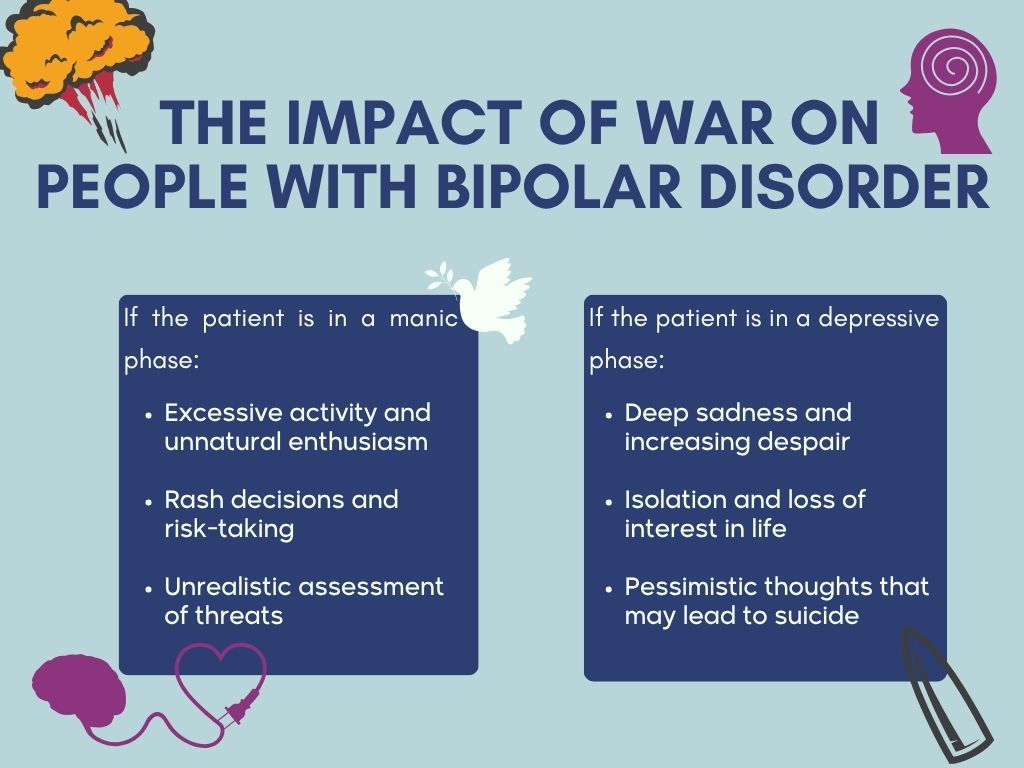
With all these challenges and tragedies that Reham faced, it was important to understand how bipolar disorder interacts with the reality of war, which further complicates the psychological state of those affected by this disorder. In this context, Dr. Borji explained that a patient with bipolar disorder is not like any ordinary person going through war or crisis. They experience severe mood swings that alternate between depressive episodes and episodes of mania or hypomania, which makes the impact of war on them completely different.
These volatile mood swings place people with bipolar disorder in a cycle of compounding challenges during times of crisis and war, where difficult circumstances alone are not enough to undermine their psychological stability. Rather, their mood disorder combines with external circumstances to create a daily battle for survival and psychological balance.
While Reham was experiencing her violent internal struggle, surrounded by the chaos of displacement and the pressures of war that added new burdens to her mental disorder, her experience was not representative of all people with bipolar disorder. As Dr. Borji explained, each patient has their own story, which varies depending on their condition and the episode they are going through. Reham's experience was fraught with feelings of sadness, despair, and anxiety, as she found herself trapped between her illness and the harsh conditions of war, making every moment she experienced feel like a new battle.
In contrast, Carmen's case reflected a different picture of psychological suffering in times of war. Carmen was not deeply depressed, but she was also not in a state of excessive happiness or activity, as in manic episodes. Her condition was closer to one of relative stability, or what could be called “relative calm” in the midst of the storm.
She was not overwhelmed by feelings of sadness or loss, but she was not immune to the effects of stress and anxiety caused by the events around her. Carmen described that period as feeling like she was in a state of constant anticipation, as if she were preparing for what might happen, but she did not lose the ability to cope with her daily life. She lived in a relatively safe place in the Chouf,
where her aunt and her children, who had fled from areas more affected by the war, took refuge and joined Carmen and her family, adding a new human dimension to the experience. Carmen did not tend to isolate herself excessively, nor did she suffer from a complete loss of energy or willpower, but she felt a different psychological burden, the burden of constant fear of the unknown and the stress resulting from the succession of events.
These subtle differences between Reham and Carmen's conditions highlight how bipolar disorder interacts with external circumstances in different ways depending on the nature of the patient's mood. While Reham was in a severe depressive phase that was exacerbated by the war, Carmen was trying to maintain her mental balance amid a state of constant but less severe stress. This shows that war does not affect everyone in the same way, but rather interacts with mental disorders to create complex and varied individual experiences.
Despite all the clips and quick tests that may be posted on social media with titles such as: “Find out if you have bipolar disorder in five minutes,” the reality is far from that simple. There are no home tests that can give you an accurate diagnosis of such a complex disorder, and no video clip or public post can accurately determine your mental state.
Bipolar disorder is not a mood swing or a bad day followed by a good day. It is a medical condition with clear diagnostic criteria based on a comprehensive assessment by a qualified psychiatrist, taking into account the patient's personal history, symptoms, their severity, duration, and impact on daily life. Any attempt at self-diagnosis without consulting a specialist may lead to adverse results, either by creating unjustified panic or by ignoring a real problem that is silently worsening.
More dangerously, the person may become convinced that they have bipolar disorder and begin to justify their behavior or emotional swings without seeking actual treatment, or take psychiatric medication based on random advice, which could put their mental and physical health at risk.
Therefore, the first step in understanding what we are going through psychologically does not start on the internet, but in the clinic, in an honest and safe session with a doctor who knows how to listen, read between the lines, and provide an accurate diagnosis that is the beginning of a real journey of treatment, not just playing the role of a patient in an online test.
Perhaps one of the biggest challenges facing those who seek to understand themselves and diagnose their psychological conditions is accessing appropriate care in the face of harsh economic and living conditions. Even after overcoming the psychological and social obstacles associated with seeking help, the financial barrier remains a powerful one, as the cost of psychological treatment is a real obstacle to continuity and commitment, especially after the recent crises that have paralyzed the health sector and exacerbated by the war, which has not only damaged buildings and homes, but also affected people's mental well-being and limited their access to treatment.
Amidst this scene fraught with fear and loss, some initiatives and institutions are emerging that seek to provide psychological support at nominal prices, attempting to fill the care gap and give hope to patients and their families. Among these entities, the Islamic Health Organization stands out as a prime example of an institution that understands the depth of the crisis and offers psychological therapy sessions at affordable prices in its clinics throughout Lebanon. These initiatives are a lifeline for many individuals who, without them, would not be able to continue treatment or even consider it.
Psychological treatment is not a luxury, but an urgent human need and a fundamental right for everyone who suffers, whether in times of peace or under the weight of war. In a country where crises abound and doors are closed to those in need of help, these initiatives remain a glimmer of hope, restoring some balance to minds exhausted by anxiety and souls torn apart by fear, and confirming that support is possible and recovery is not impossible.
Ultimately, no one should feel alone in their struggle with themselves. Every person, no matter what their suffering or ups and downs, deserves to be listened to, understood, and loved. Mental health is not a weakness, and asking for help is not a shame, but rather the highest form of courage and awareness.
Those who have lived in the heart of war or suffered from unseen internal turmoil know how precious that hug, that kind word, or that one session with a specialist can be in saving a life.
Every individual has the right to find someone who cares about them, to feel that they are seen, that their pain is not a burden but a call for compassion and support.
Don't wait for things to get worse before asking for help, and don't compare your pain to that of others. Every pain deserves to be heard, and every wound needs time to heal. Life, despite everything we go through, is worth living, and you deserve to be well.